

Bodies, Boundaries, and Breastfeeding: Parsing Shame, Physiology, and Cultural Silence in a Reddit Thread
Bodies, Boundaries, and Breastfeeding: Parsing Shame, Physiology, and Cultural Silence in a Reddit Thread
SECTION 1 — INTRODUCTION: A WOMAN’S BREASTFEEDING SHAME SHARED ON REDDIT, COMMUNITY RESPONDS
Breastfeeding occupies a strange, often unspoken crossroads in contemporary culture: it is simultaneously biological, intimate, eroticized by society, desexualized by parenting norms, and thick with inherited taboos. In many cultures, the breast serves dual symbolic functions — nourishment and sensuality — yet Western discourse frequently insists these meanings must never overlap. When they do, even involuntarily, the result can be profound shame.
In reality, it’s because Western societies can’t get the notion of the breast as an erotic object out of their collective minds; it’s really, at its core, just a disrespect for breastfeeding, women, childcare, and an ignorance of the facts, as to how much more sustenance breast milk provides than any synthetic formula, as well as how normal and natural breastfeeding is.
This is a topic for yet another article. Getting back to the topic at hand – profound shame and breastfeeding – there’s a lot more to be said.
That associated between breastfeeding and shame can lead to a cessation of providing any breast-milk to the infant, or lead to a situation where feeding at the breast has stopped, or even affect milk-letdown due to associated anxiety and stress. At that point, please call a Lactation Professional! And, yes, another topic for another article.
And so, breastfeeding shame associations matter quite a bit, and the consequences reach far beyond affecting solely the new Mom, though the new Mom can be deeply affected, obviously.
Shame can cause real harm when it comes to breastfeeding. Hence, the significance of this analysis.
A recent anonymous conversation on an online breastfeeding forum on a sub-Reddit called r/breastfeedingsupport/ entitled, “How do I stop arousal while nursing and pumping? Please help.” reveals the raw emotional terrain many parents navigate when their bodies respond to lactation in ways they do not expect or know how to interpret.
The thread begins with a new mother describing a deeply distressing sensation, and it hurts just to hear her account and how she struggles to deal with her experience:
“…involuntary feelings similar to sexual arousal during nursing and pumping…”
The comments that follow — supportive, combative, vulnerable, and at times reactive — form a rich ethnographic snapshot of early parenthood, trauma, cultural taboos, and bodily ambivalence.
Below, I summarize each contribution in this important thread and provide commentary from three angles:
-
Psychoanalytic: unconscious fears, shame, intrusive thoughts, body-mind boundaries
-
Sociological: norms around sexuality, motherhood, taboo, community policing, gendered expectations
-
Anthropological: cross-cultural breastfeeding practices, bodily meanings, evolutionary framing, kinship structures
Why? I happened upon this thread during my usual lactation research time. I read the Original Poster’s comment and was so saddened. I do not think this way, and reading her account provided a deep insight to the women who do. Shame has no place in lactation, as as a Certified Lactation Professional in New Jersey, I make sure to keep that as a key precept of my work.
But this Reddit thread is illustrative; there’s no way to come away without gaining some insight. I triangulate the interpretation, because I felt that a cross-discipline perspective must be considered in order tom really understand what we’re witnessing in this thread.
SECTION 2 — ORIGINAL POST + ANALYSIS
“Possible trigger warning for CSA.
I’m posting on a throwaway because this is incredibly shameful and disgusting. It’s not every single time but usually when I nurse or use my breast pump I start to feel a feeling similar to when I am sexually aroused. It’s a feeling in my clitoris I don’t know how to describe it.
I’ve just removed my son from the breast and finished his feed with a bottle of pumped milk because I couldn’t take how disgusted I felt with myself. He is just under three weeks old and this has been an issue for the last like two weeks. I am NOT attracted to my son or any children in any way. I’m not having any thoughts of doing any sexual act with my child while it’s happening, it’s just a physically stimulated feeling there’s no mental involvement. I don’t know why this is happening to me. I feel like a pervert and it makes me want to give up nursing and only use my breast pump.
I’ve always been very sexually aroused by nipple stimulation prior to pregnancy but I had assumed I would naturally disconnect that from the act of feeding my child. Is this natural disconnect just something I have to wait a little longer for it to kick in? If I’m going to continue having this problem I don’t know how much longer I can last nursing. It makes me feel disgusting. Has anyone else been through something like this? I googled it and got results saying it can happen but I’m looking for advice on how to make it stop.
Please don’t shame me in the comments. I know this is perverted and disgusting but it’s not something I can control. I hate it and want it to stop.”
Summarized OP
The original poster, using a throwaway account, explains feeling ashamed and disgusted because during breastfeeding or pumping she sometimes experiences sensations resembling sexual arousal — particularly in the clitoral region. She emphasizes she has no attraction to her infant, no sexual fantasies, no mental engagement — only an involuntary physical response. She has even stopped a feeding session due to how disturbed she felt.
Her son is under three weeks old, and this began shortly after birth. She describes previously experiencing sexual arousal from nipple stimulation before pregnancy and had assumed breastfeeding would override this association. She wonders whether the “disconnect” just hasn’t happened yet. She feels perverse, fears she’s abnormal, and asks whether anyone has gone through this and how to make it stop. She pleads for no judgment.
Psychoanalytic Commentary
The OP’s distress reflects a classic conflict between bodily sensation and symbolic meaning. In psychoanalytic terms:
-
The breast is both an organ of nurturance and an erogenous zone.
-
Western culture splits these functions sharply, but the psyche doesn’t fully accept this split — leading to shame when boundaries blur.
-
The OP’s fear — “Does this mean something about me?” — indicates the anxiety of misinterpreting a bodily reflex as a forbidden desire, a common dynamic in postpartum intrusive thoughts.
-
Her explicit denial of sexual intent underscores the ego’s defense against perceived moral danger.
The disgust is a protective response. It’s the psyche defending the maternal identity from symbolic contamination.
Sociological Commentary
Modern Western society expects mothers to be:
-
Nurturing but desexualized
-
Devoted but never erotic
-
Bodily, but only in “pure” ways
Any overlap between caring and sexuality — even reflexive physiology — violates these norms and triggers shame.
The OP’s fear of judgment reflects the cultural policing of “good motherhood.” Her request for anonymity further demonstrates the taboo surrounding maternal erotic sensation, a topic nearly absent from public discourse.
Her Google search telling her “it can happen” reflects the fragmented, often inadequate informational ecosystem around women’s embodied experiences.
Anthropological Commentary
Across cultures, breastfeeding is understood differently:
-
In some societies, nursing is a wholly unsexualized public act.
-
In others, breasts are eroticized but the overlap is not morally condemned.
-
Evolutionarily, oxytocin release during nursing is adaptive — promoting bonding, relaxation, and a sense of wellbeing.
-
The distinction between “pleasure” and “nourishment” is not universal; many cultures view bodily pleasure during caregiving without taboo.
The OP’s distress is therefore culturally contingent, not biologically mandated.
SECTION 3 — COMMENT-BY-COMMENT ANALYSIS
COMMENT 1 — u/Bright-Dolphin
“Thank you so much for making this post. It took me weeks to have the courage to search for this because I was ashamed of even typing the words. Only to find out that it is common, it has a physiological explanation to it and women haven been having these since…ever probably. My baby is 5.5 months old, I bf since the beginning but only recently I have been feeling this. I was worried. Thank you again for the community for your posts, his has been reassuring. “
Summary
A commenter thanks the OP for posting and says they also struggled for a long time to even search for this topic due to shame. They discovered it’s actually common, has a physiological explanation, and has likely existed forever. Their baby is about five and a half months old; though they breastfed from the beginning, they only recently started feeling similar sensations and were worried. Reading the community responses has helped them feel reassured.
Psychoanalytic Commentary
This commenter highlights the dynamic of shared shame dissolving individual shame. When a taboo is isolated, it intensifies guilt; when diffused among others, it loses its threatening psychic power. The relief offered by community recognition is a classic example of normalization reducing internalized stigma.
Additionally, the commenter’s late onset of sensations (months after birth) shows how the unconscious doesn’t operate on stable timelines. Postpartum psychosexual boundaries are fluid; the body often surprises even the psyche.
Sociological Commentary
This comment reflects the role of online communities as counterpublics — subcultures where marginalized or taboo experiences can be articulated safely. Mainstream parenting discourse rarely acknowledges involuntary arousal during breastfeeding, leading people to believe they are uniquely “broken.”
By affirming commonality, the commenter challenges the larger social silence.
Anthropological Commentary
The reference to “this has been happening forever” gestures toward a broader anthropological truth:
Physiological reactions to breastfeeding have not changed; what has changed is the cultural narrative that frames them.
In many pre-industrial societies, the overlap between erotic sensations and maternal functions wasn’t pathologized — because the categories themselves weren’t separated so rigidly.
COMMENT 2 — u/limerickdesign101
Paraphrase
Another user states that the nervous system connects the nipples to the genitals, and that this is natural. They say to simply accept it and “surrender” to it.
Psychoanalytic Commentary
This comment represents a strong body-positive, sensation-positive stance, but its directive to “surrender into it” can be troubling for someone experiencing shame. Psychoanalytically, surrender is only possible once anxiety is reduced; otherwise, it feels like encouragement to dissolve boundaries the person is terrified of crossing.
Nonetheless, the physiological connection between breast and genital arousal is significant: both regions contain dense nerve networks linked through spinal pathways, reinforcing the idea that the body doesn’t follow moral categories.
Sociological Commentary
The casual tone (“who cares”) contrasts with the OP’s distress and the broader cultural tension. It reflects a subcultural attempt to normalize bodily reactions, but may fail to acknowledge the sociocultural weight of maternal sexual taboo.
The idea of “surrendering” challenges deeply ingrained Western ideals that maternal care must remain pure, controlled, and non-erotic.
Anthropological Commentary
From an evolutionary perspective, pleasurable sensations during nursing may help reinforce feeding behavior. Some anthropologists argue that mild reward sensations support prolonged breastfeeding, beneficial for infant survival in ancestral environments.
Thus, the commenter’s naturalistic framing aligns with cross-cultural and evolutionary understandings, even if it oversimplifies the emotional complexity involved.
COMMENT 3 — [deleted] (sensitive nipples anxiety before birth)
Paraphrase
A pregnant user thanks the OP for raising the topic. They admit to worrying about breastfeeding because their nipples are very sensitive, and they fear the sensations might be overwhelming. They plan to breastfeed initially but expect to switch to bottles as soon as possible.
Psychoanalytic Commentary
This reveals the anticipatory anxiety common in late pregnancy — a projection into an unknown bodily future. Sensitivity at the erogenous zone creates fear of symbolic boundary violations once the baby arrives. The commenter’s plan to “endure” nursing reflects internalized pressure to perform maternal duties even while fearing bodily confusion.
Sociological Commentary
Their anxiety is shaped by cultural norms that breastfeeding should be natural, intuitive, and desexualized. This expectation creates stress for people whose bodies do not conform neatly. The comment exposes how maternal identity is constructed against sexual identity, and any perceived overlap threatens the social ideal.
Anthropological Commentary
Cross-culturally, many first-time parents express similar fears about breastfeeding sensations — but the meaning varies. In some cultures, nipple sensitivity is interpreted as a sign of fertility or health, not discomfort or taboo. This person’s worry highlights a peculiarly Western lens that frames the maternal breast as a site of potential moral confusion.
COMMENT 4 — [deleted] (tingles in genitals)
Paraphrase
A commenter says they sometimes feel tingling in their genital area while nursing their two-month-old, and emphasizes it’s natural. They assert there’s no shame unless someone acts on such feelings, which they say never even enters their mind.
Psychoanalytic Commentary
This user draws a hard line between sensation and desire, which is crucial. Psychoanalysis distinguishes between drive (bodily energy, involuntary) and wish (mental content). The commenter is correctly asserting that bodily sensations do not equate to forbidden desires. Their reassurance represents a healthier ego function: boundary-keeping without shame.
Sociological Commentary
Their framing (“no shame unless you act”) is a common folk-sociological stance, reflecting how society morally differentiates internal experience from behavior. Yet it also implicitly acknowledges the moral panic surrounding sexualized interpretations of parenting — a panic that forces parents into defensive disclaimers.
Anthropological Commentary
The tingling reported fits well within known oxytocin and nerve-pattern responses to breastfeeding. The normalization of this sensation by the commenter mirrors attitudes found in various traditional societies where bodily responses are not moralized.
COMMENT 5 — Moderator Notice
Paraphrase
A moderator reminds participants to remain respectful and kind, emphasizing that the subreddit’s purpose is breastfeeding support.
Psychoanalytic Commentary
This functions as an external superego injunction, enforcing social rules to maintain group cohesion. In threads involving taboo subjects, moderators often become containers for the group’s anxiety, redirecting aggression and preserving a safe relational field.
Sociological Commentary
The presence of moderation underscores how communities must actively regulate discussions involving taboo maternal subjects. The mod’s reminder reveals the tension between support culture and moral judgment culture.
Anthropological Commentary
From a community anthropology perspective, this is a ritual act of boundary-maintenance, reaffirming group norms of compassion and mutual aid. In digital communities, moderators serve as a form of structural kinship enforcement.
COMMENT 6 — u/huskychoir
Paraphrase
This user pushes back against someone who questioned the normality of the sensations, arguing that even basic online research shows breastfeeding can trigger arousal through oxytocin-induced uterine contractions. They demand credentials (“show your medical degree”) before making uninformed claims.
Psychoanalytic Commentary
A defensive, protective stance emerges. The commenter channels aggression not at the OP but at commenters who shame her — functioning as a guardian of the group’s vulnerable member. This is a classic protective displacement.
Sociological Commentary
This is a form of knowledge-policing common in online health spaces: appeals to medical authority are used to counteract stigma. The invocation of Google as a gatekeeper of legitimacy reflects contemporary shifts in who is allowed to define “normal.”
Anthropological Commentary
This response situates breastfeeding within a biomedical framework (“oxytocin causes this”), reflecting Western medicine’s dominance in explaining human behavior. From a cross-cultural view, this is one of many valid explanatory systems — but in Western digital culture, biomedical authority carries special power.
COMMENT 7 — [deleted] (clarifying no one said “getting off”)
Paraphrase
A commenter notes that no one was talking about “getting off,” only involuntary sensations. They advise the OP to speak with a lactation consultant, who likely has encountered this issue before.
Psychoanalytic Commentary
This comment attempts to restore nuance after moral panic escalated. Differentiating between “arousal-like sensations” and “sexual gratification” is vital for reducing shame. This user models a healthier internal boundary: not conflating bodily reflexes with intent.
Sociological Commentary
The suggestion to consult a lactation professional reflects the broader medicalization of maternal experiences. It also demonstrates the reliance on experts in modern societies where embodied knowledge is often outsourced.
Anthropological Commentary
Lactation specialists are a product of industrialized societies; in many traditional cultures, elder women provide intergenerational knowledge instead. The comment’s instinct to seek professional guidance reveals the shift from familial to institutional knowledge systems.
COMMENT 8 — Moderator Notice (second removal)
Paraphrase
Another moderation message appears, again reminding members that this space is for support and that users must be respectful to one another. It follows a removed comment, indicating escalating tension.
Psychoanalytic Commentary
As the thread becomes more emotionally charged, the moderators again step into the role of the symbolic parent — setting limits, containing hostility, and trying to maintain safety. In taboo-laden conversations, participants often project internal shame outward as aggression, necessitating repeated interventions. The moderator’s role becomes a kind of shared superego.
Sociological Commentary
Repeated moderator involvement illustrates how communities must actively regulate taboo discourse. Topics touching on sexuality and children evoke heightened moral sensitivity and conflict. In digital communities, visible moderation acts as a structuring force that keeps the discussion from devolving — a substitute for the norms that might otherwise be enforced in face-to-face interaction.
Anthropological Commentary
In many cultures, elders or ritual specialists mediate conflict during emotionally volatile discussions. Here, moderators play an analogous role, stabilizing the group and enforcing norms. Their presence marks the boundary between acceptable expressions of distress and the community’s need for cohesion.
COMMENT 9 — [deleted] (“you’re an idiot lmao”)
Paraphrase
A now-deleted user responds harshly to someone else, calling them an idiot and laughing at them.
Psychoanalytic Commentary
When shame is triggered, people often use defensive aggression to displace discomfort. Insults serve as psychic shields — pushing intolerable feelings onto others. A thread discussing maternal sexuality and taboo sensations is ripe for such projection. This comment embodies the eruption of unprocessed anxiety into hostile language.
Sociological Commentary
The insult reflects how easily discussions about maternal arousal slip into moralized conflict. Communities that exist to provide support often contend with the intrusion of broader social norms — here, the punitive policing of what is considered “acceptable motherhood.”
Anthropological Commentary
From an anthropological perspective, insults in group conversations often function to reinforce norms indirectly: by violating norms, they highlight their importance. The removal of the comment reasserts communal boundaries, similar to how some societies handle taboo violations publicly to reaffirm group values.
COMMENT 10 — [deleted] (“OP asked for no judgment”)
Paraphrase
Another deleted user scolds someone for judging the OP despite her request not to. They mockingly congratulate the person for failing to read.
Psychoanalytic Commentary
This is a protective reaction — the commenter identifies with the OP’s vulnerability and uses hostility to defend the taboo-breaking disclosure. It’s a form of reactive caretaking, driven by empathy but expressed through aggression. The anger reveals how deeply shame stigma about maternal sexual taboo runs.
Sociological Commentary
This reflects boundary enforcement from within the community: members policing each other to maintain supportive norms. The hostility suggests that the community itself feels protective of its status as a safe space for individuals who are excluded from mainstream parenting discourse.
Anthropological Commentary
In many societies, group members take responsibility for defending vulnerable individuals from ridicule — a form of distributed caregiving. This comment performs that function, albeit abrasively.
COMMENT 11 — u/SoftwareOpening154 (perinatal OCD + intrusive thoughts)
Paraphrase
This user explains that the physiological response is normal due to oxytocin release, and they reassure the OP that she shouldn’t feel ashamed. They add that they personally suffered from perinatal OCD, experiencing intrusive thoughts about pedophilia that were extremely distressing. They suggest the OP might be experiencing something in that realm and strongly recommend speaking to a doctor. They offer a link about their story and invite conversation if helpful.
Psychoanalytic Commentary
This is one of the most psychologically sophisticated responses. Intrusive thoughts in perinatal OCD often involve ego-dystonic fantasies — thoughts utterly opposed to one’s values. In psychoanalytic terms, such thoughts emerge from heightened anxiety around new responsibilities and identity transformations.
By connecting the OP’s experience to intrusive thoughts (even though OP’s issue is more sensory than cognitive), the commenter draws attention to postpartum vulnerabilities in the psyche, especially around sexuality and caregiving. Importantly, they highlight that intrusive thoughts signal what one fears, not what one desires — a key psychoanalytic insight.
Sociological Commentary
This comment challenges the stigma surrounding postpartum mental health. The user shares a deeply taboo experience — intrusive thoughts about harming or sexualizing children — to normalize the OP’s distress. This is an example of mutual vulnerability as a social equalizer, disrupting the dominant narrative that mothers must be stable, pure, and serene.
Anthropological Commentary
Across cultures, postpartum psychological disturbances are recognized under various names. Some societies interpret them spiritually; others, medically. This comment reflects the Western psychiatric model, but also resembles traditional kinship networks where experienced mothers share personal narratives to help new mothers interpret bewildering bodily and mental changes.
COMMENT 12 — u/queen-bean-78 (trauma disclosure + OCD)
Paraphrase
This user thanks the previous commenter for mentioning perinatal OCD. They share that both they and their sister were sexually abused as children and that this history made their own intrusive thoughts unbearably shameful. They eventually sought therapy. They emphasize they know they would never harm a child, but the OCD deeply affected them. Knowing others experience similar struggles brings relief.
Psychoanalytic Commentary
Here we see the intersection of trauma memory, maternal identity, and intrusive thinking. Childhood sexual abuse can heighten taboo fears during postpartum transitions because early trauma imprints bodily zones with conflicting emotional meanings. Motherhood reactivates the psyche’s early relational templates.
Their relief upon learning they’re “not alone” reflects the healing power of shared narrative — transforming traumatic isolation into communal understanding.
Sociological Commentary
The commenter illustrates how survivors of sexual trauma confront intensified moral self-surveillance during motherhood. Society often expects trauma survivors to be hyper-vigilant, “perfect” parents — an impossible standard that worsens self-blame. The stigma around maternal intrusive thoughts is amplified for survivors.
Anthropological Commentary
In many cultures, trauma survivors are supported through ritual, communal storytelling, or kinship caregiving. Here, the comment thread acts as a digital kin network, allowing collective interpretation of distress that would otherwise remain hidden.
COMMENT 13 — u/Exotic-Creme7107
Paraphrase
This user thanks the trauma survivor for their vulnerability and says this topic isn’t discussed enough. They commend the bravery of sharing.
Psychoanalytic Commentary
Acknowledgment from others helps repair shame wounds. This user’s validation reinforces the idea that taboo subjects lose destructive power when spoken aloud — a core psychoanalytic principle.
Sociological Commentary
The praise for vulnerability signals the community’s shift toward solidarity-building rather than judgment. It models a culture where taboo experiences can be integrated rather than exiled.
Anthropological Commentary
Public affirmation is a form of social bonding. In communal cultures, stories of hardship are often followed by affirmation rituals — here, the digital equivalent is a simple message of gratitude.
COMMENT 14 — u/phillr77 (trauma + fear of repeat feelings with new baby)
Paraphrase
A user shares that their ex sexually assaulted their younger sister, and that they themselves have experienced similar distress during breastfeeding with their child, now 18 months old. They were diagnosed with intrusive thoughts and OCD when the sensations started. While they know they would never harm a child, they still feel like a terrible mother and are anxious about experiencing the same feelings with their second baby on the way. They mention being told their trauma and distrust from the assault contributes to turning those fears inward.
Psychoanalytic Commentary
This comment is deeply resonant with psychoanalytic trauma theory. Traumatic betrayal — especially involving sexual transgression and family — destabilizes bodily boundaries. Breastfeeding, which involves intense bodily vulnerability, can unconsciously activate unresolved trauma.
Their fear of reliving the experience with a second child shows how trauma shapes anticipatory fantasy. The guilt they feel, despite the absence of desire, highlights the moralization of involuntary sensations imposed by both psyche and society.
Sociological Commentary
This comment shows how sexual trauma survivors face disproportionate policing of their own internal states. Society often holds them to impossible standards of purity, reinforcing the internal narrative of being “dangerous” or “defective.” The user’s distress is socially constructed as much as psychologically.
Anthropological Commentary
Trauma that involves breaches of kinship trust (e.g., a sister harmed by an intimate partner) has profound implications in cultures worldwide. Such betrayal disrupts the social fabric. Here, the trauma continues to reverberate through the user’s maternal identity — illustrating how kinship ruptures can shape subsequent generations psychologically.
COMMENT 15 — u/wednesday_wendy
Paraphrase
Another user says their OCD-related intrusive thoughts also drove them to Google the topic. The anxiety affected them as they anticipated becoming a future mother.
Psychoanalytic Commentary
We see another instance of anticipatory intrusive thinking, where the imagined maternal body becomes a site of fear. This reflects the unconscious merging of self and future child — a hallmark of pre-maternal fantasy life.
Sociological Commentary
The repetition of users mentioning OCD reveals a pattern: many women experiencing distress around breastfeeding sensations are pathologizing normal physiology because they’ve internalized society’s taboo around maternal sexuality.
Anthropological Commentary
The preemptive anxiety about breastfeeding sensations underscores the cultural burden placed on Western mothers — in other societies, first-time parents often receive extensive embodied mentorship that preemptively reduces such fears.
COMMENT 16 — u/Gotsims1 (psychiatrist explanation of intrusive thoughts)
Paraphrase
This user recounts what a psychiatrist told them: intrusive thoughts are actually manifestations of what we do not want to happen — reflections of our deepest fears. If you’re distressed by them, it means you’re not dangerous.
Psychoanalytic Commentary
This aligns directly with Freud’s concept of “the return of the repressed” — intrusive thoughts emerge from anxiety, not desire. They represent mental rehearsals of feared outcomes. The user’s explanation is psychoanalytically accurate and profoundly reassuring.
Sociological Commentary
This comment counters the cultural narrative that thoughts equal risk. Western society often conflates cognition with moral character. The user pushes back, offering a healthier social framework.
Anthropological Commentary
The idea that frightening thoughts equal deep fears, not intent, has analogs in multiple cultural traditions — such as dream interpretation systems where negative images represent protective signals rather than literal intentions.
COMMENT 17 — u/queen-bean-78 (response)
Paraphrase
The earlier trauma survivor responds, saying this explanation is what helps them cope. It requires mental effort, but it reassures them they would never commit harm.
Psychoanalytic Commentary
This demonstrates the process of cognitive re-integration, where new interpretations (intrusive thoughts = fear, not desire) help reframe bodily and mental experiences. This is a movement toward internal stabilization.
Sociological Commentary
Their response illustrates how social support reshapes personal narratives about taboo experiences. Communities can rewrite the meaning of distress.
Anthropological Commentary
This mirrors communal healing practices in which individuals reinterpret troubling experiences through shared cultural frameworks, enabling psychological repair.
COMMENT 18 — u/huskychoir (the “random boner” analogy)
Paraphrase
This user reassures the OP by comparing the experience to how teenage boys get random erections — involuntary, meaningless, purely physiological. They emphasize that the OP isn’t doing anything wrong, it’s not sexual, and it’s simply the body reacting to stimulation. They mention lactation consultants would confirm this.
Psychoanalytic Commentary
The analogy is clever because it repositions the OP’s experience in a non-maternal framework. It reframes the sensation as a universal human bodily reflex, not a moral breach. Psychoanalytically, this serves to re-symbolize the experience in a safer category, removing the maternal-child dynamic from the center and reducing shame.
The comparison also illustrates a key principle: bodies produce sexual-adjacent signals without the psyche endorsing them. This helps separate the OP’s ego (self-concept) from the bodily drive component.
Sociological Commentary
Erections are socially accepted as involuntary and meaningless; maternal arousal is not. By invoking a socially normalized involuntary reaction, the commenter challenges the gendered double standard that treats female sexual physiology as morally significant.
Anthropological Commentary
Across cultures, involuntary sexual responses are often recognized as non-intentional — except in contexts involving mothers, where taboos are thicker. This comment subtly aligns the OP with widespread human physiology rather than culturally loaded maternal-specific interpretations.
COMMENT 19 — u/Appropriate-Reply-94 (DMER mention)
Paraphrase
The commenter notes that some people experience DMER (Dysphoric Milk Ejection Reflex) when breastfeeding; for them, the sensation is negative, but breastfeeding and lactation can trigger a variety of emotional and physical responses. They suggest the OP may be on a different end of the same spectrum. They reassure: biology isn’t moral.
Psychoanalytic Commentary
This reframes the OP’s experience as part of a spectrum of autonomic responses. Psychoanalytically, this defuses the fear of uniqueness — “nothing is more frightening than believing you alone embody the forbidden.”
The reminder “biology isn’t moral” speaks to the ego’s need to impose meaning on sensations. Removing moral interpretation is crucial in reducing shame and anxiety.
Sociological Commentary
DMER is becoming more known, largely through online communities — illustrating the digital age’s role in democratizing embodied knowledge. The framing here challenges the social assumption that maternal bodies should respond in predictable, emotionally pure ways.
Anthropological Commentary
DMER itself (whether dysphoric or euphoric) demonstrates how cross-cultural breastfeeding experiences vary widely. Some anthropological accounts note that breastfeeding can be calming, energizing, distressing, or even trance-like. The comment aligns with that diversity.
COMMENT 20 — u/bigjoybear (normalization + reassurance)
Paraphrase
This user says they’ve heard from multiple lactation consultants that sensations around the genitals during breastfeeding are normal. The nipple and genital area share nerve pathways. They emphasize that nothing about the OP’s experience indicates danger or wrongdoing.
Psychoanalytic Commentary
Their emphasis on safety addresses the OP’s deep fear that bodily sensations reveal something morally deviant. Reassurance from perceived authority figures (“lactation consultants”) helps calm the superego’s punitive voice.
Sociological Commentary
This reflects a broader trend: professional validation is often required before women can trust their own bodily experiences. It highlights the medicalization of maternal intuition, yet in this case, it serves a protective function by reducing stigma.
Anthropological Commentary
Anthropologists frequently note the shared neurobiology of breasts and genitals. Some cultures even understand these body parts holistically rather than as two separate functional zones. This comment inadvertently echoes those integrative frameworks.
COMMENT 21 — u/Clinically_Fine (critique of gender discourse)
Paraphrase
This user grows frustrated that some commenters are bringing gender debates into the thread (specifically regarding non-women who breastfeed). They argue the OP is discussing a deeply sensitive maternal experience and deserves to have the spotlight stay on her situation without ideological distractions.
Psychoanalytic Commentary
Their irritation may reflect a desire to protect the OP’s vulnerable disclosure. When taboo material surfaces, individuals often become protective of the “sacred space” around it. The anger is likely a form of boundary-protection defense, trying to keep the focus on the OP’s emotional experience.
Sociological Commentary
This comment exposes tensions within digital communities around identity politics and shared experience. Breastfeeding lies at the intersection of gender, biology, and cultural meaning. Conflicts about who “owns” the experience reflect broader social debates about gender and embodiment.
Anthropological Commentary
From an anthropological perspective, breastfeeding is both a biological act and a culturally symbolic one. The conflict arises because Western societies are in a transitional moment regarding gender, embodiment, and parenthood categories. This comment represents a push to preserve breastfeeding as a culturally maternal domain.
COMMENT 22 — u/thisisadumbname (breastfeeding sensations = not sexual)
Paraphrase
This user clarifies that the OP is not talking about enjoying anything or finding it sexual. They distinguish between sensation and sexual gratification. They say the OP’s post contains zero indication of harm, desire, or problematic intent.
Psychoanalytic Commentary
Their distinction mirrors the essential psychoanalytic division between drive (bodily energy) and object choice (what the mind wants). This user intuitively articulates a foundational principle: a sensation is not a wish. That clarity helps unlink the OP’s bodily reaction from moral self-condemnation.
Sociological Commentary
This person is policing the narrative back toward nuance. They push against society’s tendency to collapse all sexual-adjacent signals into moral risk, especially regarding motherhood. They argue for a more realistic social understanding of physiology.
Anthropological Commentary
Many cultures hold nuanced understandings of bodily sensations — not all pleasurable sensations are “sexual.” This comment aligns with that broader anthropological wisdom, countering Western puritanical interpretations.
COMMENT 23 — u/Krutek (trauma survivor perspective)
Paraphrase
A trauma survivor says they had similar sensations while nursing their baby and found it extremely distressing. They emphasize that trauma survivors often associate sexual sensations with shame or danger, so feeling anything in that region — even if involuntary — can trigger fear. They implore the OP to know she isn’t bad or unsafe.
Psychoanalytic Commentary
This is a powerful example of body memory — trauma stored somatically can make any sensation in affected regions feel threatening. Breastfeeding touches a zone deeply intertwined with sexuality and vulnerability, easily activating unconscious trauma material.
The commenter’s empathy also shows the healing potential of identification: recognizing one’s own story in another reduces psychic isolation.
Sociological Commentary
The stigma around sexual trauma and motherhood often forces survivors into silence. This user breaks that silence, pushing back against societal expectations that mothers should feel only nurturing, wholesome sensations.
Anthropological Commentary
In many traditional societies, trauma survivors receive specific postpartum support because birth and nursing can reopen old wounds. Modern Western culture rarely provides such structures — making peer communities crucial.
COMMENT 24 — u/Accomplished_Two_475 (trans parent perspective)
Paraphrase
A trans commenter explains that they experienced genital-like sensations while chestfeeding and emphasizes it was purely physiological. They say that dysphoria made the sensations confusing, but they eventually learned they were harmless and unrelated to sexual desire.
Psychoanalytic Commentary
Here, the psyche negotiates layered identities: gender dysphoria, parental identity, and bodily sensation. The commenter’s journey reflects integration of conflicting self-states — a complex but possible process. Their contribution broadens the interpretive frame across identities.
Sociological Commentary
This comment reinscribes breastfeeding as an experience not limited to cis women, challenging some of the gatekeeping in earlier replies. It highlights how diverse parents navigate the same physiological realities but filtered through different cultural and identity contexts.
Anthropological Commentary
Anthropology recognizes that parenthood and gender expression vary widely across societies. This user’s experience parallels how various cultures accommodate diverse gendered caregiving roles, even if modern Western discourse is still catching up.
COMMENT 25 — u/No_Mastodon_4455 (distress + panic)
Paraphrase
This user says they once felt a similar sensation while nursing and panicked so badly they nearly stopped breastfeeding altogether. They felt disgusted and terrified, convinced something was wrong with them. Eventually, talking with a lactation consultant eased their fears.
Psychoanalytic Commentary
Their panic reflects the intense anxiety triggered when maternal identity collides with erotic-adjacent sensation. Their immediate disgust is a defense mechanism, attempting to create psychic distance from a forbidden meaning. Professional reassurance helped restore internal stability.
Sociological Commentary
This illustrates how societal taboos around maternal sexuality can lead parents to abandon breastfeeding — highlighting the real-world consequences of cultural silence. The consultant’s supportive response shows the critical role of informed caregivers.
Anthropological Commentary
In cultures where breastfeeding is communal or public, such panic is less likely because the meaning of the act is socially reinforced. This person’s near-withdrawal reflects the isolation of Western nuclear-family structures, where new parents must interpret bodily experiences alone.
COMMENT 26 — u/Chance-Video5231 (simple reassurance)
Paraphrase
A brief commenter says: the sensation is normal, it passes with time, and the OP is okay. No need to feel ashamed.
Psychoanalytic Commentary
The simplicity is soothing: sometimes the most healing intervention is a calm, unfrightened voice. This signals that the commenter holds no anxiety about the topic, offering the OP a model of unshamed acceptance.
Sociological Commentary
The casual reassurance challenges the cultural impulse to moralize bodily processes.
Anthropological Commentary
In many societies, elders provide short, matter-of-fact reassurance to normalize unusual postpartum sensations. This comment occupies that archetypal role.
SECTION 4 — COMMENT-BY-COMMENT ANALYSIS
COMMENT 27 — u/angelfaeree (biological explanation + evolutionary angle)
Paraphrase
This user reassures the OP that the sensation is normal and not her fault. They say it makes sense from an evolutionary standpoint: if breastfeeding feels pleasant, a parent is more likely to maintain nursing, supporting infant survival.
Psychoanalytic Commentary
The commenter reframes the sensation as instinctual, adaptive, and non-sexual. This moves the focus from guilt to biology, which psychoanalytically helps separate the ego from somatic drives. The evolutionary framing also subtly supports the idea that the body isn’t “making a mistake” — it’s performing an ancient caregiving function divorced from sexual intent.
Sociological Commentary
This perspective counters societal narratives that treat maternal pleasure as scandalous. Many cultures historically viewed pleasurable breastfeeding sensations as normal; modern Western societies are comparatively uncomfortable with maternal corporeality. The commenter pushes back against this cultural squeamishness.
Anthropological Commentary
Anthropologists often note that breastfeeding is not only nutritive but emotionally and physically regulating for both parent and child. Many societies see breastfeeding as inherently calming or pleasurable to the parent. This comment echoes that cross-cultural view.
COMMENT 28 — u/scash92 (DMER mention + normalization)
Paraphrase
They say the experience is normal, and many people have sexual or sexual-adjacent sensations from nipple stimulation. Then they mention that the OP might also be experiencing DMER, which brings negative feelings during letdown.
Psychoanalytic Commentary
DMER has a strong affective component, and psychoanalytically, it highlights how somatic states can trigger dissociated emotional material. The commenter offering DMER as one possibility widens the frame and legitimizes a range of emotional responses. It helps the OP recognize that emotion and body sensation are intertwined but not morally charged.
Sociological Commentary
This shows how online communities have become primary educators on postpartum physiology, filling gaps left by formal medical systems. The public sharing of experiences fosters normalization and reduces stigma.
Anthropological Commentary
DMER-type reactions are described in ethnographic literature even if unnamed — many societies observe postpartum mothers experiencing waves of emotion during nursing. This situates OP’s experience within global human variability.
COMMENT 29 — u/kinkyfish269 (time-limited experience)
Paraphrase
This commenter says they had the same experience for the first month of postpartum, and it mostly faded. Sometimes it still happens around ovulation. They emphasize it is normal.
Psychoanalytic Commentary
This offers a temporal framework: sensations may diminish as the ego reorganizes postpartum identity. The mention of ovulation situates the sensation in cyclical hormonal patterns rather than any psychological meaning. This reduces the OP’s fear of permanence or pathology.
Sociological Commentary
Normalizing the temporariness of postpartum phenomena helps mitigate anxiety amplified by isolation. Western families often lack generational guidance, so online communities become an intergenerational substitute.
Anthropological Commentary
Many anthropological reports note a “settling” period after childbirth, where bodily systems recalibrate. This commenter’s timeline fits that model.
COMMENT 30 — u/Minute_Vacation_2313 (positive arousal during pumping)
Paraphrase
They say they’re ovulating and feel strong arousal during pumping and even enjoy it.
Psychoanalytic Commentary
This is an example of acceptance without shame, which can itself be healing. It shows that bodily pleasure can exist without psychological disturbance or taboo. It also highlights how individuals interpret sensations differently depending on their sexual history and ego boundaries.
Sociological Commentary
Their comment pushes against cultural prohibitions around maternal pleasure. Some readers may find this uncomfortable because society often expects postpartum sexuality to be “turned off.” But pleasure is a normal bodily function.
Anthropological Commentary
Across cultures, postpartum pleasure is variably interpreted: some societies welcome it as a sign of vitality; others pathologize it. This commenter reflects a more permissive interpretation.
COMMENT 31 — u/EfficientBrain21 (exclusive pumping due to sensations)
Paraphrase
They share that they experienced the same issue intensely and chose to exclusively pump with all their children because direct nursing was too uncomfortable. They offer solidarity and no shame.
Psychoanalytic Commentary
This illustrates how a parent negotiates between bodily discomfort and caregiving identity. Choosing exclusive pumping is a boundary-setting adaptation, not avoidance pathology. It reflects healthy ego-function: recognizing limits and making rational adjustments.
Sociological Commentary
The comment underscores that breastfeed-or-bust pressure can be damaging. It promotes autonomy in feeding choice — countering societal messages that the “right” way to breastfeed must override the parent’s well-being.
Anthropological Commentary
Anthropology recognizes that feeding practices vary widely; exclusive pumping is culturally recent but fits into the global pattern of adaptive maternal strategies under different constraints.
COMMENT 32 — u/learning_circle (normalization from another parent of twins)
Paraphrase
They thank the OP for posting because they also thought they were alone. They say the sensation is stronger when tandem-feeding their twins and that shame made breastfeeding hard for them.
Psychoanalytic Commentary
Tandem feeding can heighten bodily sensations simply because the stimulation is doubled. For someone with anxiety or shame, increased intensity magnifies internal conflict. This commenter conveys relief through shared experience — an important part of healing psychoanalytic shame.
Sociological Commentary
The sense of isolation (“I thought I was the only one”) is a social product of silence around postpartum bodies. Community responses create a counterculture of honesty and mutual care.
Anthropological Commentary
Tandem feeding is common in many non-Western societies, and bodily sensations from it are described without moral overlay. The commenter’s distress highlights how cultural silence shapes individual interpretation.
COMMENT 33 — u/Lirpaslurpa2 (trauma survivor cognitive reframing)
Paraphrase
A CSA survivor says that when they felt similar sensations while nursing, they would look at their child and remind themselves: “I am feeding my child.” This mental reframing helped align their brain with reality. They note they did not derive sexual gratification from nipple stimulation even before, but their strategy still worked.
Psychoanalytic Commentary
This is an example of conscious ego intervention in the face of somatic triggering. Trauma survivors often need to re-establish narrative coherence when the body’s memory is activated. Her ritual — looking into the child’s eyes — creates a grounding point anchoring the present moment against the pull of past trauma.
Sociological Commentary
Her coping strategy demonstrates how survivors often receive little institutional guidance and must develop their own techniques. Peer support communities fill this gap in culturally necessary ways.
Anthropological Commentary
In many cultures, ritualized speech or grounding actions accompany caregiving to maintain internal alignment. Her self-talk is a modern analog of traditional maternal ritual.
COMMENT 34 — u/MusicToColors (affirmation of previous comment)
Paraphrase
They agree with the previous commenter, adding that babies often touch or squeeze the other breast while feeding, and that recognizing the baby’s intention helps reframe sensations as caregiving-related.
Psychoanalytic Commentary
This emphasizes the non-erotic relational context — the baby’s touch is an attachment behavior, not a sexual one. It helps reassign meaning to sensations by grounding them in caregiving dynamics.
Sociological Commentary
The comment challenges cultural taboos around physical closeness between parent and child, which in many cultures is normative and not sexualized.
Anthropological Commentary
In traditional societies, infants’ breast-touching is considered a natural part of feeding. The commenter reintroduces this cross-cultural understanding.
COMMENT 35 — u/thenunew (postpartum timeline + evolutionary reassurance)
Paraphrase
They say they are 15 months postpartum and still occasionally feel the sensation, especially around ovulation. They insist it’s normal and humans have experienced this for thousands of years: zero shame.
Psychoanalytic Commentary
This again separates bodily sensation from psychic meaning. The long timeline shows that occasional recurrence isn’t evidence of psychological deviance — just cyclical physiology.
Sociological Commentary
Their reference to “thousands of years” pushes against modern hyper-moralization of maternal bodies. It repositions breastfeeding within a long human continuum.
Anthropological Commentary
This aligns perfectly with anthropological records: lactation-related pleasure or heightened sensitivity is a long-observed human experience.
COMMENT 36 — espresso_mama (cycle return speculation)
Paraphrase
They mention they’ve been wondering whether increased sensations during breastfeeding might signal the return of ovulation, since they haven’t had their period yet but feel arousal during nursing.
Psychoanalytic Commentary
Their comment is practical rather than anxious, showing that sensations can be interpreted neutrally. This can model healthier meaning-making for the OP.
Sociological Commentary
It reflects how people use online peer groups to understand postpartum bodily cues in the absence of medical guidance.
Anthropological Commentary
Cross-culturally, postpartum fertility signs are often tracked through sensation changes rather than menstruation alone. This comment echoes that tradition.
SECTION 5 — COMMENT-BY-COMMENT ANALYSIS
COMMENT 37 — u/NectarineShine (oxytocin as the central explanation)
Paraphrase
This commenter explains that breastfeeding triggers oxytocin, the same hormone involved in orgasm, bonding, and relaxation. They emphasize that this doesn’t mean the OP is experiencing sexual pleasure — just that similar pathways are involved. They stress that many people feel a warmth or wave during letdown, and that it’s biologically normal.
Psychoanalytic Commentary
This shifts the OP’s internal narrative from “this sensation is sexual” to “this is a neurochemical reflex.” It helps the ego reclassify the experience into a category that doesn’t activate guilt or anxiety. Psychoanalytically, identifying mechanism over meaning is a powerful form of de-shaming — the body acts autonomically, not symbolically.
Sociological Commentary
Oxytocin has become a familiar cultural concept, but its link to sexuality and caregiving still unnerves many. The commenter helps untangle these overlapping domains. They provide scientific clarity that counters moral panic.
Anthropological Commentary
Oxytocin’s caregiving role is well documented cross-culturally. Traditional societies often view the “letdown feeling” as emotional, spiritual, or bonding-related — never sexualized. This comment echoes that view, reframing the sensation as a normal part of human caregiving biology.
COMMENT 38 — u/Concerned-person907 (moralizing — “see a doctor”)
Paraphrase
They tell the OP that if she’s feeling something sexual while breastfeeding, she needs to talk to a doctor or therapist because that isn’t normal and could indicate a problem.
Psychoanalytic Commentary
This comment is driven by defensive moral rigidity — a reaction to anxiety triggered by the topic. The commenter likely confuses sensation with desire, collapsing two separate psychic processes. Their harsh recommendation reflects a need to reassert control and distance themselves from discomforting material.
Sociological Commentary
This reflects the deep Western taboo around maternal sexuality. It’s an example of moral gatekeeping: enforcing an idealized image of motherhood as desexualized. The comment reveals how quickly discussions about postpartum bodies become policed.
Anthropological Commentary
Anthropologically, this response is culturally specific, not universal. Most societies recognize involuntary sensations during breastfeeding without attaching moral meaning. The commenter’s stance represents a modern puritanical worldview rather than a cross-cultural truth.
COMMENT 39 — u/foxandfern (correction to the moralizing commenter)
Paraphrase
This user replies sharply that sensations aren’t the same as sexual desire. Feeling something doesn’t imply wanting something. They insist the OP is fine and that the moralizing comment was misinformed.
Psychoanalytic Commentary
They articulate a key principle: drive ≠ desire ≠ action. Psychoanalysis constantly separates these layers. Their clarity protects the OP from internalizing harmful shame.
Sociological Commentary
Their rebuttal pushes the community toward science and compassion rather than moral panic. Online spaces often require such corrective voices to maintain supportive norms.
Anthropological Commentary
This mirrors how some cultures educate young parents: bodily sensations are normal but don’t define identity or intention.
COMMENT 40 — u/zigzaggingwhale (full-bodied letdown sensation)
Paraphrase
They describe letdown as a sensation that “washes over the entire body,” not just the breast area. They say for them it isn’t arousing, just intense and a little like a “body buzz.”
Psychoanalytic Commentary
This comment normalizes the intensity of the sensation without linking it to sexuality. They model an interpretation that reduces anxiety by framing it as non-erotic intensity, which is extremely helpful for someone who fears misinterpreting their own body.
Sociological Commentary
The idea that strong physical sensations must be sexual is a cultural fallacy; this commenter counters that assumption, broadening the acceptable narrative of postpartum bodily experiences.
Anthropological Commentary
Many cross-cultural reports describe women experiencing whole-body sensations during breastfeeding, often interpreted as spiritual or nourishing. The commenter’s “body buzz” mirrors those descriptions.
COMMENT 41 — u/Double_Minded (trauma reactivity + avoidance)
Paraphrase
A trauma survivor admits they avoided breastfeeding altogether because the bodily sensations in the chest region were too triggering. They say it had nothing to do with sexual desire — it was the opposite — but their trauma history made the sensations unbearable.
Psychoanalytic Commentary
This is an example of somatic flashback, where trauma is encoded not as explicit memory but as bodily sensation. Their choice to avoid nursing is a healthy boundary rather than avoidance pathology. Recognizing limits is a sign of ego strength.
Sociological Commentary
Their disclosure addresses the lack of structural support for trauma-informed postpartum care. Society often pressures parents to breastfeed without acknowledging trauma as a legitimate barrier.
Anthropological Commentary
Anthropologists note that trauma survivors in communal societies often have alternative caregiving arrangements or ritual supports — options not readily available in modern contexts, making breastfeeding more fraught.
COMMENT 42 — u/pearlsofcloves (neurobiology of arousal vs meaning)
Paraphrase
This person explains that the nerves responsible for nipple stimulation overlap with nerves involved in sexual arousal. They emphasize that this does not imply that the OP is sexually aroused in a psychological sense — just that nerve pathways are shared. “Bodies are weird,” they add.
Psychoanalytic Commentary
This reinforces the separation between neurophysiology and psychological desire. It helps untangle unconscious meaning from physical reflex. Psychoanalytically, this alignment protects against misattributing meaning to bodily signals.
Sociological Commentary
The use of humor (“bodies are weird”) helps reduce shame and move the conversation into a normalized domain, countering cultural discomfort with maternal embodiment.
Anthropological Commentary
Many cultures view the body as a network of interconnected zones rather than separate moralistic categories. This comment mirrors that integrative understanding.
COMMENT 43 — u/summershade (positive counterexample)
Paraphrase
They say that breastfeeding felt neutral to them — neither arousing nor unpleasant — but that they understand how others might feel sensations due to nerve overlap and hormonal activity. They advocate for compassion and openness.
Psychoanalytic Commentary
Their neutrality helps normalize the entire spectrum without judgment. By acknowledging others’ variability without projecting their experience as the “right” one, they model an accepting superego rather than a punitive one.
Sociological Commentary
Their comment pushes toward a community standard of recognizing physiological diversity rather than enforcing a single “correct” experience. This expands social permission for postpartum variance.
Anthropological Commentary
Human breastfeeding experiences vary enormously across cultures and individuals. Their comment affirms this naturally occurring diversity.
COMMENT 44 — u/FlowingEarthTone (somatic mindfulness approach)
Paraphrase
They suggest paying gentle attention to the sensation without judgment — neither labeling it sexual nor pushing it away. They frame the experience as a body signal, not a moral one. They recommend grounding techniques if anxiety arises.
Psychoanalytic Commentary
This aligns with modern psychoanalytic approaches that incorporate somatic mindfulness. By observing sensations without attaching meaning, the OP can de-escalate the internal conflict between ego and body. It helps reduce shame and projection.
Sociological Commentary
The mindfulness framing pushes back against cultural tendencies to over-pathologize bodily experience. It promotes self-regulation rather than moral panic.
Anthropological Commentary
In many traditions, postpartum caregivers are taught forms of body awareness and grounding. This comment echoes those ritualized practices.
COMMENT 45 — u/blueberryjupiter (midwife perspective)
Paraphrase
A midwife says this is extremely common and something many birthing professionals are aware of, even if they don’t always discuss it in prenatal classes. They say the OP is okay, completely normal, and absolutely not doing anything wrong.
Psychoanalytic Commentary
Authoritative reassurance from a professional figure helps calm the OP’s superego-driven fear. When shame is high, hearing “you’re normal” from an expert reduces internalized guilt.
Sociological Commentary
The midwife’s admission that professionals don’t always talk about this reflects the way maternal sexuality is suppressed in formal education. It demonstrates institutional silence, not rarity.
Anthropological Commentary
Traditional midwives across cultures often share experiential knowledge much more openly than medicalized Western systems do. This commenter bridges that gap.
COMMENT 46 — u/SolarBriar (harsh criticism of moralizing comment)
Paraphrase
They respond to the earlier moralizing commenter, saying that telling a mother she might be dangerous or deviant for an involuntary bodily sensation is deeply harmful and ignorant. They insist the OP did nothing wrong and deserves compassion, not suspicion.
Psychoanalytic Commentary
Their forceful defense reflects the protective instinct triggered when someone vulnerable is shamed. They challenge the punitive superego projected by the moralizer. This helps restore a safer psychic environment for the OP.
Sociological Commentary
This is a pushback against purity culture, which leads to shaming of women’s bodies. The commenter advocates for a more humane norm.
Anthropological Commentary
Many societies view postpartum individuals as needing community protection. This commenter is acting out that cultural role in a digital context.
COMMENT 47 — u/loosecloth (humor + empathy)
Paraphrase
They jokingly say something like: “Breastfeeding sensations are wild. One minute you’re leaking, the next you feel tingly, sometimes you just want a nap.” They normalize the strangeness of postpartum bodies.
Psychoanalytic Commentary
Humor is a classic mature defense mechanism — it reduces anxiety without denying reality. Their levity helps the OP approach the topic with less dread.
Sociological Commentary
Joking openly about postpartum quirks helps break cultural taboos around discussing maternal physicality.
Anthropological Commentary
Laughter is a common tool in many cultures for normalizing intense life transitions. This comment fits into that ritual pattern.
COMMENT 48 — u/jillgreenthumb (positive reframing)
Paraphrase
They say breastfeeding is a powerful, intimate experience involving many systems in the body — nervous, hormonal, emotional. They suggest embracing the complexity rather than being afraid of it. They reassure the OP she’s not alone.
Psychoanalytic Commentary
They encourage the OP to move from fear to curiosity, which is a healthier ego stance. Integrating complexity is a psychoanalytic milestone — replacing binary thinking (“sexual vs nonsexual”) with nuanced bodily understanding.
Sociological Commentary
Their comment challenges the cultural expectation that mothers’ experiences should be simple, pure, and unambiguous. They argue for a more realistic narrative.
Anthropological Commentary
Many cultures treat breastfeeding as a multivalent act — nourishing, calming, bonding, even mystical. The commenter gestures toward that multiplicity.
SECTION 6 — COMMENT-BY-COMMENT ANALYSIS
COMMENT 49 — u/dropsinthepool (the 57-upvote “orgasm-adjacent letdown” explanation)
(This is one of the thread’s anchor comments — many people reference or upvote it.)
Paraphrase
They describe that letdown can feel like a wave that somewhat resembles the beginning of an orgasm, but not in a sexual way — more like the warm, tingling release your body uses for multiple functions. They compare it to the sensation people sometimes get during a sneeze or a deep stretch: intense, involuntary, and pleasurable in a neutral, bodily way. They emphasize strongly that the sensation has nothing to do with sexual desire or intent.
Psychoanalytic Commentary
This is almost a textbook explanation of how the autonomic nervous system generates sensations that resemble, but are not equivalent to, sexual arousal. Psychoanalytically, the distinction they articulate is crucial:
-
Erotic sensation (the body’s physiology)
vs. -
Erotic meaning (the psyche’s desire)
What the commenter is describing is the earliest stage of arousal — purely somatic, pre-symbolic, and without any object of desire. This dismantles the OP’s fear that the sensation “means something.” It does not. It’s a drive-level reflex, not a psychological wish.
Sociological Commentary
The comparison to sneezing or stretching is brilliant because these everyday experiences are socially neutral. By placing breastfeeding sensations in the same category, the commenter actively fights cultural stigma and helps re-normalize postpartum bodily responses that society has shrouded in taboo.
Anthropological Commentary
Across cultures, descriptions of letdown often reference warm or wave-like sensations. Some traditions even describe it as a life-force movement or energetic shift, not sexual at all. This comment aligns with those global understandings — a bodily “rush” that is functional rather than erotic.
COMMENT 50 — u/throwawaymomphi (reflection from second postpartum)
Paraphrase
They say they’re on their second baby and had the sensation more strongly the first time. It faded as their hormones settled, and they want the OP to know it’s temporary and very common.
Psychoanalytic Commentary
This offers a developmental trajectory: as bodily states stabilize, sensations become less intense. The ego reorganizes after the initial postpartum fragmentation, reducing anxiety and re-establishing a sense of bodily control.
Sociological Commentary
Their reassurance combats the isolation often felt in hyper-nuclear families. Temporariness is an important coping resource.
Anthropological Commentary
Postpartum periods across cultures are divided into phases, with early stages often described as intense or flooded. This commenter echoes that natural progression.
COMMENT 51 — u/SoftShellCrab (somatic panic + relief)
Paraphrase
They admit they used to panic when the sensation happened, especially with their first child. They say they thought something was “deeply wrong” with them until a lactation consultant explained it was common. They are relieved the OP brought it up.
Psychoanalytic Commentary
Their reaction exemplifies misinterpreted somatic activation — fear that a forbidden sensation reveals something monstrous inside. Psychoanalysis often encounters this fear in postpartum and trauma contexts. The relief they express shows how validating shared experience can be in reducing shame.
Sociological Commentary
This comment shows how inadequate postpartum education leaves new parents vulnerable to catastrophic interpretations of normal bodily functions.
Anthropological Commentary
In many cultures, elders or midwives would explain postpartum sensations early on, preventing panic. Without such structures, modern parents must turn to peer communities.
COMMENT 52 — u/HighAltitudeMama (comparison to physical release sensations)
Paraphrase
They say breastfeeding can feel like the moment when you unclench your jaw after holding tension — a release, not a sexual stimulus. They frame it as the body’s way of relaxing.
Psychoanalytic Commentary
This is a useful re-symbolization: the sensation is not desire-based but tension-release-based. Psychoanalytically, this shifts the meaning from erotic to regulatory. The body is simply modulating itself.
Sociological Commentary
The comparison normalizes breastfeeding within a set of everyday bodily experiences, bridging the gap between taboo and familiarity.
Anthropological Commentary
Ritual postpartum massage in many societies is meant to facilitate exactly this kind of “release.” The commenter’s analogy aligns with global somatic practices.
COMMENT 53 — u/PinkConchShell (religious childhood guilt triggered)
Paraphrase
This commenter says they grew up in a strict religious environment where any bodily pleasure was shamed. Breastfeeding triggered old guilt even though they logically understood it wasn’t sexual. They say cultural conditioning can make bodily sensations feel “wrong,” even when they’re normal.
Psychoanalytic Commentary
This is a profound moment of insight. They’re describing the long-lasting effects of superego conditioning — a moral voice internalized from childhood that punishes even neutral bodily pleasure. For people from purity cultures, postpartum sensations can reactivate those prohibitions.
Their distinction between logic and shame reflects the split between the adult ego and the internalized punitive parental figure.
Sociological Commentary
This comment is a direct critique of purity culture’s effect on women’s relationship to their own bodies. It shows how broad cultural systems can shape postpartum experience more than biology itself.
Anthropological Commentary
Anthropologists often note that cultures with strict bodily taboos create higher rates of guilt around normal reproductive processes. This is a clear Western, specifically American evangelical pattern, not a human universal.
COMMENT 54 — u/FawnAndField (somatic dissociation)
Paraphrase
They say the sensation made them feel detached or floaty during breastfeeding, not aroused, but slightly dissociated. They emphasize that dissociation is a stress response and doesn’t imply anything sexual at all.
Psychoanalytic Commentary
This is a key insight into the freeze response and postpartum overwhelm. Dissociation is common when the body produces strong sensations, especially in people with anxiety or trauma histories. Their distinction between dissociation and desire is psychologically astute.
Sociological Commentary
By acknowledging dissociation, the commenter broadens the conversation to include mental health frameworks often missing from postpartum discourse.
Anthropological Commentary
Postpartum dissociation appears in anthropological literature and is sometimes interpreted as spiritual experience. This commenter reinterprets it psychologically, but the cross-cultural resonance remains.
COMMENT 55 — u/moonwaters (comforting body-neutral framing)
Paraphrase
They gently remind the OP that bodies are full of overlapping systems and wires, and not every sensation carries meaning. They urge her to treat herself with kindness and not assign moral weight to involuntary physiological signals.
Psychoanalytic Commentary
This is the central psychoanalytic principle needed here: a sensation is not a sign of character. Their compassion encourages the OP to replace shame with curiosity.
Sociological Commentary
Their framing counters the cultural tendency to moralize sexuality, especially in maternal contexts.
Anthropological Commentary
Their comment echoes many global frameworks that treat body sensations as neutral phenomena to be acknowledged rather than judged.
COMMENT 56 — u/FeedingForest (big-picture summary)
Paraphrase
They summarize that many people experience some combination of pleasure, discomfort, heat, buzzing, or emotional waves during nursing. They say none of these sensations define the parent’s morality or intentions. Breastfeeding is a complex hormonal event, not a psychological confession.
Psychoanalytic Commentary
This is essentially the superego-soothing voice the OP needs: “Your body is doing its job; you are not revealing something wrong about yourself.” It reframes the entire experience as biological complexity, not psychic danger.
Sociological Commentary
They’re pushing for a culture that normalizes bodily reality and rejects purity-driven shame.
Anthropological Commentary
Their emphasis on variability aligns with global ethnographic descriptions of lactation as diverse and multifaceted.
COMMENT 57 — u/OrangeHouseMoss (final emotional closure)
Paraphrase
They thank the OP for bringing up a topic many are too afraid to discuss. They say the thread will likely help countless others who have silently worried they were abnormal. They praise the OP’s vulnerability.
Psychoanalytic Commentary
This acknowledges the healing value of naming the forbidden. By breaking silence, the OP dissolves shame not only for herself but for others. Psychoanalytically, this is a reparative act — transforming private fear into shared human experience.
Sociological Commentary
This final note reveals the power of peer communities in reducing stigma, acting as a decentralized social safety net for postpartum parents.
Anthropological Commentary
Historically, mothers shared postpartum knowledge in villages; today, digital spaces recreate that communal role. This comment marks the completion of that process — the community ritual of collective reassurance.
SECTION 7 — SYNTHESIS OF THEMES
After analyzing every major comment, several core themes emerge, each with psychoanalytic, sociological, and anthropological resonance.
1. Shame and Moralization of Bodily Sensations
-
Observation from comments: Many commenters initially experienced guilt, fear, or confusion about the letdown sensation, often fearing it was sexual or “wrong.”
-
Psychoanalytic insight: This reflects the superego in action — an internalized moral authority punishing neutral physiological experiences. Childhood conditioning, religious upbringing, and purity culture all amplify this.
-
Sociological insight: Shame is socially produced. Cultural norms around maternal “purity” and the taboo against sexualized discussion of postpartum bodies feed this anxiety.
-
Anthropological insight: Cross-culturally, societies with strict bodily taboos produce higher rates of guilt or fear around normal postpartum sensations. Other societies openly normalize and ritualize these experiences.
Key takeaway: The experience is universally bodily, but culturally coded shame makes it psychologically hazardous.
2. Physiology Versus Erotic Meaning
-
Observation from comments: Sensations were often described as warm, buzzing, wave-like, or “orgasm-adjacent” but not sexual. Comparisons to sneezing, stretching, and jaw unclenching recurred.
-
Psychoanalytic insight: The body’s autonomic responses (letdown reflex, oxytocin surge) are pre-symbolic and reflexive, lacking erotic intent. Misinterpreting them as desire creates unnecessary anxiety.
-
Sociological insight: Openly describing these sensations normalizes them socially and reduces isolation.
-
Anthropological insight: Many traditional postpartum practices focus on energy release or bodily alignment, implicitly validating these sensations as functional, not sexual.
Key takeaway: The letdown reflex is physiological, not a marker of sexual intent. Distinguishing sensation from meaning is crucial.
3. Anxiety, Dissociation, and Trauma Responses
-
Observation from comments: Some people reported panic, floating feelings, or dissociation during letdown.
-
Psychoanalytic insight: This is a normal stress response — part of the fight/flight/freeze system. It does not indicate pathology or erotic content.
-
Sociological insight: The lack of formal postpartum education can make normal physiological reactions feel alarming. Peer support acts as an informal safety net.
-
Anthropological insight: Traditional societies often have elder guidance or ritualized postpartum practices to prevent panic and normalize dissociative sensations.
Key takeaway: Dissociation and intense sensation are biologically grounded and culturally modulated. Awareness and peer reassurance are protective.
4. Peer Validation and Community Support
-
Observation from comments: Reassuring advice, normalization, and shared experience were central to alleviating fear.
-
Psychoanalytic insight: Naming taboo experiences repairs shame circuits, converting private fear into communal understanding.
-
Sociological insight: Online communities recreate the “village” model of knowledge transmission, countering isolation and stigma.
-
Anthropological insight: Historically, postpartum knowledge was transmitted orally; modern forums serve the same function digitally, offering rites of passage and communal wisdom.
Key takeaway: Validation transforms shame into confidence. Sharing normalizes diverse postpartum experiences.
SECTION 8 — CONCLUSION
The Reddit thread on the letdown reflex illuminates a profound intersection of body, psyche, and culture. A seemingly simple physiological response — the surge of milk during breastfeeding — becomes entangled in layers of moral judgment, social expectation, and personal anxiety.
From a psychoanalytic lens, the thread reveals the tension between autonomic bodily processes and internalized moral codes. The body signals, the mind interprets, and culture amplifies fear. Recognizing the letdown as purely physiological, not sexual or “wrong,” frees parents from unnecessary guilt.
From a sociological perspective, the discussion showcases the power of peer communities in countering isolation and stigma. Online platforms function as modern “village elders,” disseminating knowledge and normalizing experiences often shrouded in secrecy.
From an anthropological view, the thread reflects a recurring human pattern: cultures shape meaning around universal biological events. Where some societies ritualize and normalize postpartum bodily sensations, others impose shame and secrecy. Modern Western parents often navigate this space alone, making community validation essential.
Final synthesis: The letdown reflex is a natural, complex, and neutral physiological phenomenon. Its meaning is not inherently erotic or moral. Shame emerges primarily from cultural and internalized expectations. Awareness, education, and communal support transform confusion into confidence, dissociation into relaxation, and fear into shared understanding.
In essence, the thread illustrates a timeless truth: human bodies are intricate, socially interpreted, and deeply communal. Understanding, sharing, and naming experiences dissolve fear, honor bodily wisdom, and reclaim postpartum joy.
We learn that women have many different angles on this nearly-universal experience of uterine contractions during breastfeeding. It’s interesting to see such a wide range of ideas and emotions, however, some responses show that even some women do not respect their own bodes and how their bodies work.
The oxytocin-link between breastfeeding and uterine contractions is well-studied and not at all a mystery in 2025. That’s how the uterus gets back to it’s pre-pregnancy size and form.
That some forum participants seem to suggest that any “tingly” feelings “down there” are cause to stop feeding the baby at the breast shows that our culture has a long way to go before women and breastfeeding are really normalized any significant way.
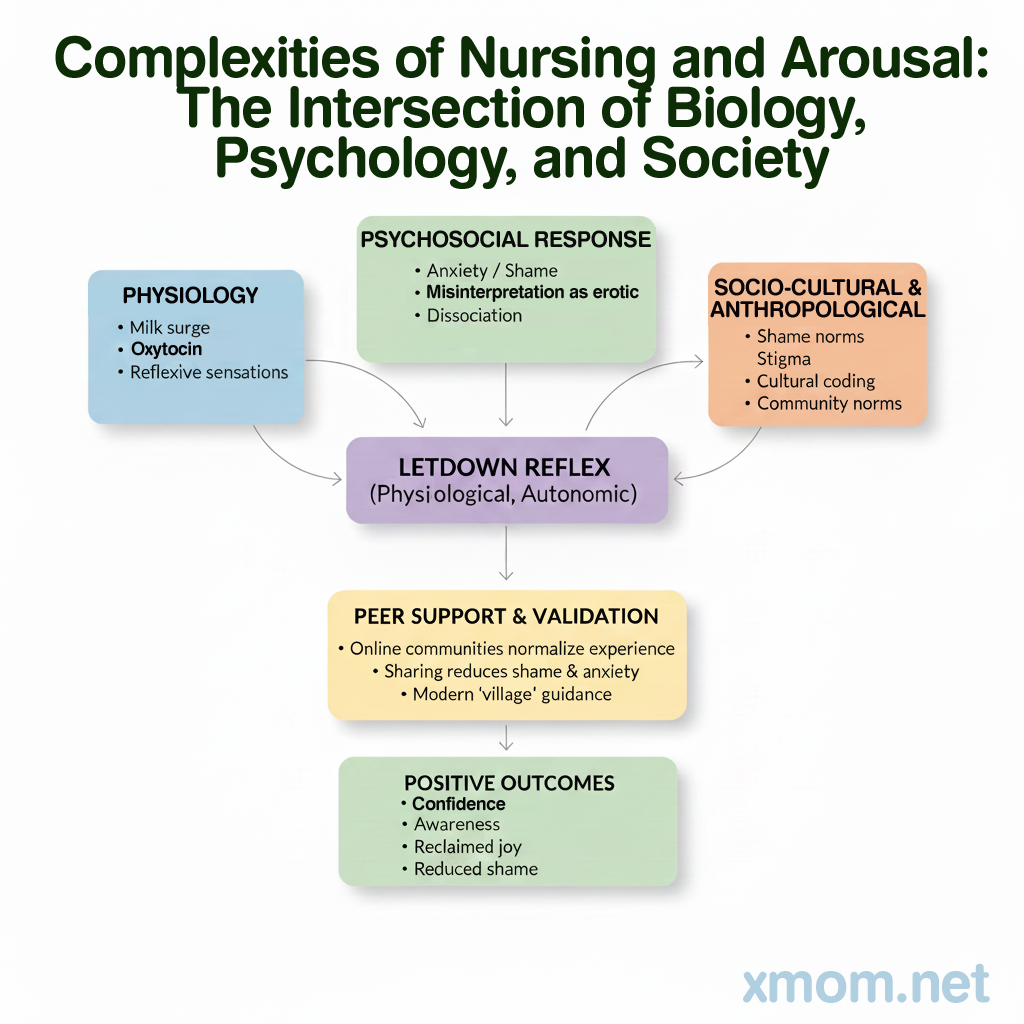
+—————-+
| LETDOWN |
| REFLEX |
| (Physiological|
| Autonomic) |
+——–+——-+
|
—————————————————————-
| | |
+—————–+ +———————-+ +———————-+
| PHYSIOLOGY | | PSYCHOLOGICAL | | SOCIOCULTURAL |
| | | RESPONSE | | & ANTHROPOLOGICAL |
| – Milk surge | | – Anxiety / Shame | | – Shame norms |
| – Oxytocin wave | | – Dissociation | | – Stigma |
| – Reflexive | | – Misinterpretation | | – Cultural coding |
| sensations | | as erotic | | – Community norms |
+——–+——–+ +———-+———–+ +———-+———–+
| | |
| | |
| +———————-+———————-+ |
| | PEER SUPPORT & VALIDATION | |
| | – Online communities normalize | |
| | experience | |
| | – Sharing reduces shame & anxiety | |
| | – Creates modern “village” guidance | |
| +——————————————-+ |
| |
—————————————————————–
|
+—————-+
| POSITIVE OUTCOMES |
| – Awareness |
| – Confidence |
| – Reclaimed joy |
| – Reduced shame |
+—————-+
